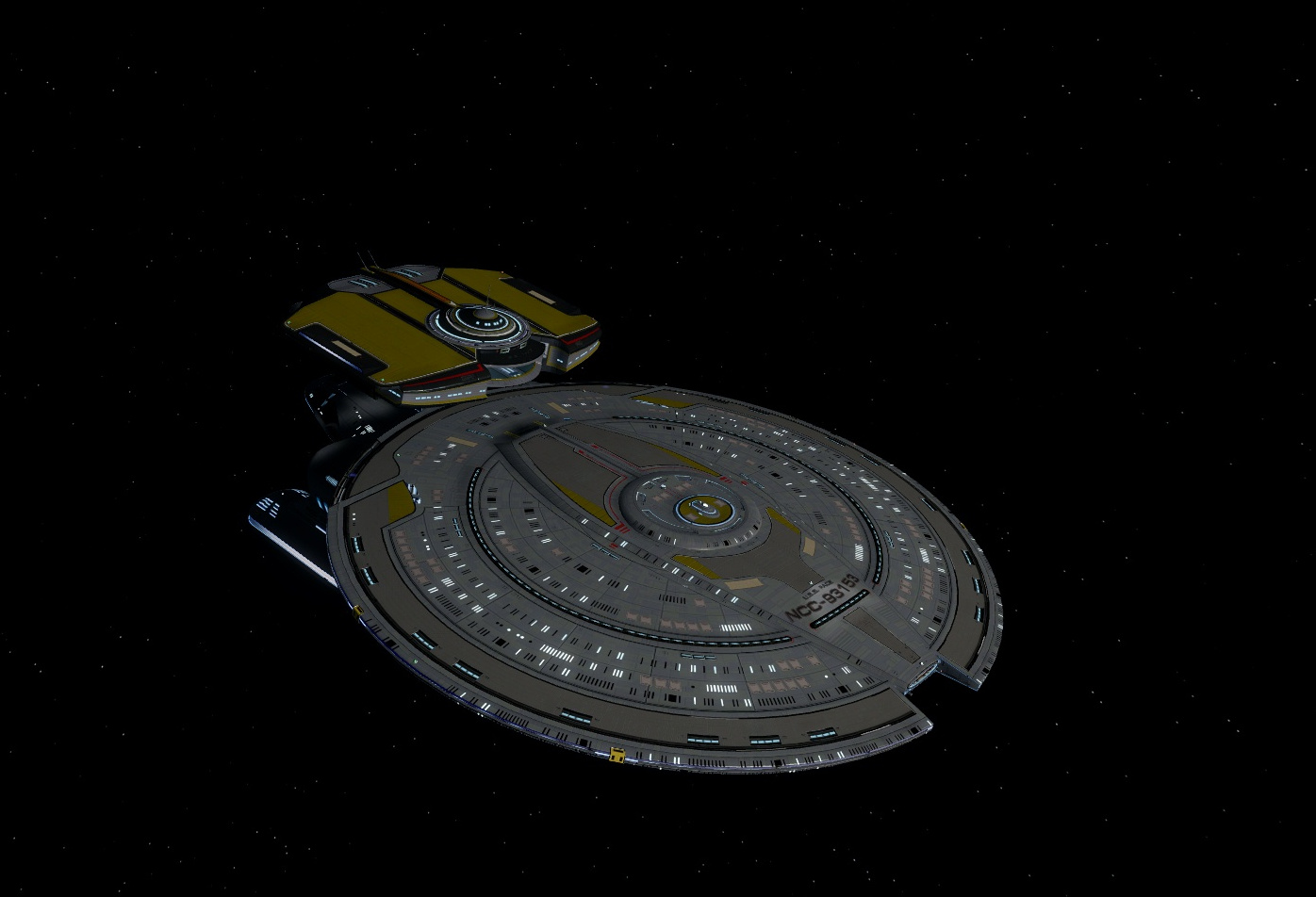
| U.S.S. PACE |
|
| Class | Sutherland Type HEVC |
| Registry | NCC-93153 |
| Owner | United Federation of Planets |
| Operator | Mutara Alliance |
| Launched | Stardate 86026 |
| Status | Active (2425) |
|
|
USS PACE
SUTHERLAND
Starship Registry
The USS Pace (NCC-93153), a heavy engineering variant of the Sutherland-class, represents a specialized evolution within Starfleet’s directive. Commissioned around 2410, the Pace was designed as a dedicated logistics, and technical support platform. This vessel is uniquely capable of extended, independent operations in complex engineering environments. Its distinctive configuration reflects a growing need for highly adaptable starships, capable of sustained infrastructure development, disaster relief, and long-term technical assistance across the vast expanse of the Federation and its growing frontier. This subclass of engineering and operations focused ships regularly assist independent colony worlds, as well as the greater infrastructure of the Alliance.
With numerous workbees, shuttles, and several runabouts housed in a specialized carrier deck, the USS Pace is able to field multiple engineering teams for a variety of tasks.
While combat was never intended as a primary role, all shuttle crew are trained in defense, and the probe launchers can readily be loaded with a selection of torpedo weapons for dire situations.
History
Genesis of the USS Pace (NCC-93153): A Heavy Engineering Carrier
Conceptualization and Construction
The USS Pace was conceived as a direct response to the increasing demand for long-duration, self-sustaining engineering and logistical support platforms in the early 25th century. Starfleet Command, recognizing the inherent adaptability of the new Sutherland-class design, initiated a specialized variant program to address these growing needs. The Pace was laid down at the Utopia Planitia Fleet Yards, one of the Federation’s premier shipyards, around 2407. Construction was completed swiftly, and the vessel was officially commissioned in 2410.
Early Shakedown
The USS Pace was officially commissioned in late 2410, following a rigorous construction and outfitting period. Its initial shakedown cruises and systems tests were conducted primarily within the Sol System. These early trials focused intensely on validating its unique engineering systems, assessing the efficiency of its auxiliary craft deployment protocols, and rigorously testing its long-duration life support capabilities. Starfleet engineers pushed the vessel’s industrial replicator banks, recycling systems, and cargo management protocols to their limits, ensuring its ability to sustain complex operations for months without resupply, a core requirement of its design.
The Pace’s inaugural missions were predominantly focused on post-conflict reconstruction and infrastructure development. One notable early assignment involved providing critical assistance in the terraforming and stabilization of Kepler-186f IV, a newly designated Federation colony world. Here, the Pace’s numerous workerbee drones were vital in the construction of orbital defense platforms, and atmospheric processors, significantly accelerating the timeline for the new settlers. The early years of service also saw the crew adapting to the Pace’s unique operational profile. Unlike traditional exploration or combat vessels, the Pace required a higher proportion of specialized personnel, including engineers, geologists, xenobotanists, and logistics specialists. Training exercises during this period heavily emphasized inter-departmental coordination for complex, multi-phase projects. One drawback is the lack of combat experience, which made early crew rotation assignments unsatisfactory when joining a front-line vessel, and required additional training when transferring to other exploration or combat focus posts.
Expanding Capabilities & Critical Support (c. 2415-2419)
As the USS Pace and its family matured in its operational capabilities, it gained a reputation (at least in engineering circles) as a premier mobile base. It was deployed to numerous critical infrastructure projects across Alliance space. The current ongoing mission will see the construction of a new deep-space sensor array in the remote Outback sector, a vital strategic asset for monitoring uncharted regions, and detecting potential new exploratory missions for dedicated deep-space craft.
The vessel’s robust cargo capacity, and extensive auxiliary craft makes it invaluable during major natural disasters, and humanitarian crises. Following the catastrophic geological shifts on Regeno II in 2417, the Pace served as a supplemental command and logistics hub for the massive relief efforts. Because of special training, and the number of qualified pilots, its flight control teams coordinated rescue shuttles, deployed medical teams to affected areas, and used the fabrication facilities to produce emergency shelters and water purification systems on a large scale. The vessel’s runabouts were critical for rapid assessment and delivery of aid to remote, otherwise inaccessible areas, proving its versatility beyond pure engineering. Furthermore, while not an explorer itself, the Pace provids crucial support for deep-space exploratory missions. Frequently tasked with establishing temporary forward operating bases for long-range exploratory vessels, offering much-needed repair facilities, resupply points, and data relay stations far beyond established Starfleet outposts. This enables explorers to push deeper into uncharted space, with greater confidence, knowing that robust support is uasually within reach.
The Corelli Mandate: Pushing the Warp Envelope
The Pace’s current warp capabilities are notable for a large vessel. Soon after Kammus had taken command of the Pace, he set about a plan to optimize the warp field geometry, and nacelle performance, for enhanced speed and greater efficiency over sustained, long-duration transits.
Nacelle-Hull Integration: Reset the nacelle pylon arrangement to that closer to the older Nebula class, in hopes of projecting a more saturated warp field. Asyncronous modes of warp geometry and subspace pressure increases adjusted relative to ongoing FTL Computer processing ability.
Field Stability and Efficiency: While the Sutherland class maintains two nacelles, the challenge is to optimize their combined field generation for improved stability, and reduced energy consumption at sustained high warp. Implement cascade dual asymmetrical field coil integration.
Subspace Field Manipulation: Explore ongoing subspace field manipulation. The goal is not merely burst speed, but a significant improvement in sustained cruising efficiency for the extended deployments.
Technical Data
Full Technical Details
| Extended Specifications |
|---|
| General Information |
|---|
| Class | Sutherland |
| Designation | Engineering Carrier |
| Hull Duration | 80 Years |
| Time Between Refits | 10 Years |
| Time Between Resupply | 5 Years |
| Dimensions |
|---|
| Length | 602.2 Meters |
| Beam | 560 Meters |
| Draft | 180 Meters |
| Mass | 3.89M Tonns |
| Personnel |
|---|
| Habitable Decks | 35 |
| Senior Officers | 80 |
| Other Officers and Enlisted Crew | 450 |
| Civilians | 100 |
| Marines/MACO | None |
| Evacuation Limit | 5000 |
| Propulsion Systems |
|---|
| Warp Drive Configuration | Twin Nacell |
| Warp Drive Units | Leeding Energies LF-43/M Dual Cascade Asyncronus |
| Primary Impulse System | Kloratis FIG-5 |
| Slipstream Drive | Offline |
| Transwarp System | Integrated drive coils, custom field geometry programming |
| Speed |
|---|
| Avg. Cruising Speed | Warp 7.6 |
| Max. Cruising Speed | Warp 8.2 |
| Emergency Speed | Warp 9.98, Superceded by Transwarp |
| Defensive Systems |
|---|
| Primary Shielding System | Symmetrical double lattice redundant subspace graviton field generators, Cascade Cyclical regenerative array. |
| Backup Shielding System | Force Field Lattice |
| Additional Defenses | Shuttle Flight Groups |
| Offensive Systems |
|---|
| Phaser Systems | Single array forward, Single Array Ventral keel mounted, Dorsal array aft. |
| Torpedo Systems | 6x multi-role multi-stage sequential probe launchers, Pattern firing, Independent Launch capable |
| Torpedo Armament |
250 Photon
50 Quantum Cascade
100 Cyclical Resonance Burst
100 Kinetic Tungsten Mass Rounds |
| Scientific Systems |
|---|
| Sensor Systems | Five sets of Long range and navigation sensors are located behind the main deflector dish. Lateral sensor pallets are located around the saucer rim. |
| Probe Systems | Standard complement of 9 different classifications, 180 stored |
| Deflector System | Gravametric Magneto Deflector Array capable of standard navigational, and forced mass driving up to 11,000 tons. |
| Scientific Laboratories |
- 1 Stellar Cartography
- 4x Planetary Science
- 2x Astrometrics
- 2x General-Purpose
|
| Engineering Facilities |
- 2 Industrial Replicators
- 46x Cargo Transporter Systems
- 2x Drafting Suites
- 8x General-Purpose Workshop
- Field deployable mobile hanger array
|
| Crew Support Systems |
|---|
| Medical Support Systems |
Main Sickbay Saucer Section Secondary Medbay Stardrive Section Emergency Response/SAR Triage bay Flight Deck
|
| Recreational Systems |
* 4 Crew Lounges
* 6 Holosuite Facilities
* 2 Gymnasium
|
| Auxiliary Information |
|---|
| Auxiliary Craft |
25 Workbees
6x Type 9A Heavy Cargo
18x Type 7 Personnel
5x Type 14 General
4x Danube Class Runabouts (Cargo Configuration)
1x Transwarp Test Yacht
|
| Specifications |
|---|
Length
Beam
Draft
Mass
|
602.2 meters
560 meters
180 meters
3.89M mt
|
| Decks | 45 |
| Standard Crew | 530 |
| Emergency Capacity | 5000 |
|
Armaments
|
2 Phaser Arrays
12 Torpedo systems
|
|
Defenses
|
Cyclical Cascade Regenerative Shielding Array
|
|
Auxiliary Craft
| 25 Workbees
30 Shuttles (various sizes)
4 Runabouts
|
Command and Control Systems
The USS Pace has been extensively reconfigured to be significantly different from that of the other Sutherland-Class vessels, internally being qualified as “HEV”, heavy engineering variant.
The carrier flight deck pod situated atop the main saucer section contains secondary command and flight control stations, able to field many auxiliary craft, and assume flight management of multiple other starships when needed. Primary flight control is managed on the main bridge, as are all other systems.
Physical Arrangement & Crew Support
Consisting of three sections: the flight deck pod, the main saucer, and the stardrive, the impressive vertical presence of the sutherland-class engineering variant is a feat of dedicated research and modification. The Sutherland-Class was designated as an Advance Research Science Cruiser, one of the largest ships fielded by Starfeet in the 2400’s, however with the extensive modifications made over two decades, the USS Pace is now classified as an Heavy Engineering Carrier. It maintains some of the scientific equipment installed in the primary hull from the beginning, but lacks the dedicated research equipment found on standard Sutherland-class ships.
35 habitable decks provide housing and accommodation for the nominal 530 crew, 100+ civilians, and passengers.
The Pace utilizes its huge interior volume by providing 23 extensive cargo bays situated over 10 internal decks, 2 industrial replication systems, multiple holoemmiter equipment recreation suits, and various other relaxation amenities for the hard working engineers. There are two sickbays, one main which houses the CMO, and one secondary in the stardrive section. An extensive triage bay is situated on the flight deck.
Cargo capacity: 325,200 metric tons
Propulsion and Power Generation
Consolidated Fusion version 12A Matter/Anti-Matter Reactor. Output: 1800 Cochranes
Normal Cruising Speed: Warp 7
Maximum Speed: Warp 9.992 for 8 hours
Transwarp Velocity: 42+
Transwarp velocity is an ongoing experiment, with generous encouragement from the Captain.
The sublight engines are adequate to move the hull, and provide exceptional stability in complex manuvers, but do not offer speed, as the ships large mass makes it difficult to balance sublight impulse performance with the requirements of the engineering mandates.
Tactical and Defensive Systems
Symmetrical double lattice redundant subspace graviton field: the regenerative system swaps between emitters in the cluster when shield integrity in a specific area drops below a predetermined percentage. This allows the active shield generator to provide protection, and additional units to be put on immediately hot standby. As the primary generator drops in integrity, power is then increased to the redundant generator which seamlessly takes over the burden of shielding that portion of the ship, allowing the previous generator to recharge before being placed on standby.
The maximum peak load is 600,012 megawatts for 1.8 seconds, provided the secondary warp core is in de-coupled mode, all fusion reactors are online, and all available energy is discharged through the shield grid. This procedure is not recommended.
Weaponry installed on the Pace is primarily for self defense, with very few Type X Phaser arrays fitted. However, the extensive probe launches fitted (six total, forward/aft) can be used with various torpedoes, which make for ample offense should the need arise. The heavy shielding, and general mass of the hull has proven adequate to protect the crew until true warships can arrive. The flight crews are trained in general combat piloting, and fielding 24 shuttles has proven to be and additional asset in conflict resolution.
Auxiliary Spacecraft
As a carrier, the Pace holds a vast array of auxiliary craft. These are mainly held in the flight bay pod, but can additionally be serviced from the Stardrive shuttlebay if needed.
The flight operations control center is capable of managing 80 independent flights continuously.
The full complement of craft includes:
25 Workbees
6x Type 9A Heavy Cargo Shuttles
18x Type 7 Personnel Shuttles
5x Type 14 General Purpose Shuttles
4x Danube Class Runabouts in Cargo Configuration
Corelli’s personal Transwarp Test Yacht
Senior Officers
| Commanding Officer | Executive Officer |
|---|
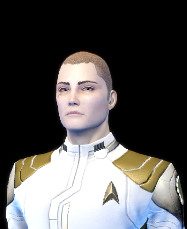
Kammus Corelli |
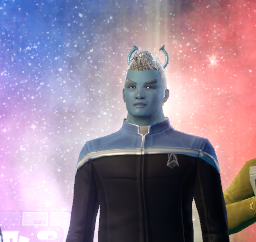
Dahlal |
| Flight Chief | Chief Engineer | Chief Medical Officer | Chief of Security |
|---|
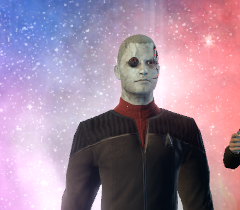
Two of Ten |
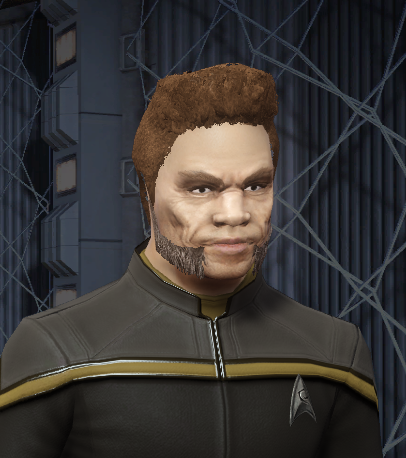
Dapus |
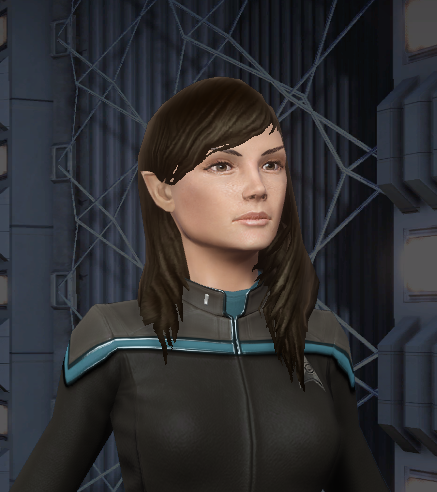
T’Vrell |
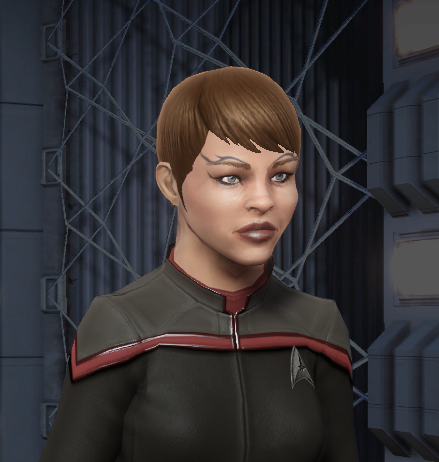
Jaeson |