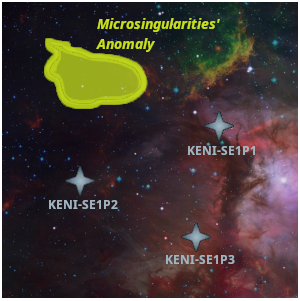
Sector 1 of Eridon Nebula is the closest to the core Klingon territories and has been explored by long-probes and a few small expeditions, of which most have disappeared without explanation. In the recent survey, Kl’Vok discovered what had exactly happened. Upon its entry, the vessel’s advancement was hindered by a region filled with micro-singularities which were leaking large amounts of tetryon radiation, suggesting that the boundary between normal spacetime and subspace was pierced through. The Kl’Vok flotilla discovered the cause of these micro-singularities. A Solanae-run space station, similar in purpose, but much more primitive compared to one destroyed by Delta Flight group in Calbriden system during the Iconian War, in its performance was slowly converting normal spacetime into a dimensional pocket which would allow the Solanae to exist normally in our dimension.
After the flotilla successfully destroyed the space station, the affected spacetime reverted back to normal, including the three star systems previously observed in Sector 1. However, the micro-singularities imploded, leaving a subspace damaged in a fashion to the explosion of Omega Molecule, but at much smaller scale. The mapping conducted by Kl’Vok and House Krotak vessels shows that large area has been damaged, but these ruptures are dispersed far apart to allow FTL travel at lower warp factors. For now, the area is simply named “Microsingularities’ Anomaly” (yellow region on the map). Three star systems have been affected in various degrees.
System KENI-S1P1
Class M3V Red Dwarf
- KENI-S1P1-I Class N (Reducing)
- KENI-S1P1-II Class B (Geomorteus)
- Inner Asteroid Belt
- KENI-S1P1-III Class J (Jovian; Gas Giant), no moons
- KENI-S1P1-IV Class C (Icy Geoinactive)
- KENI-S1P1-VI Class J (Jovian; Gas Giant), 2 moons
- Outer Asteroid Belt
- KENI-S1P1-VII Class C (Icy Geoinactive)
- KENI-S1P1-VIII Class C (Icy Geoinactive)
- KENI-S1P1-IX Class J (Jovian; Gas Giant), no moons
Brief summary:
The star system is home to a red dwarf incapable of supporting a meaningful habitable zone due to its low luminosity and surface temperature. Only the first planet shows signs of tectonic activity but given its Class N nature, the dense greenhouse atmosphere makes any planetary visits difficult. The system contains two asteroid belts rich in ferrite and silicate-based ores, as well as traces of post-transition metals. One of two moons of the sixth planet contains low purity dilithium. Mining is possible but the profitability of it is questionable. The gas giants exhibit expectedly strong magnetic fields which can screen sensory scans.
The system is to be considered of no strategic importance to the Empire.
System KENI-S1P2
Class DO1 White Dwarf
System KENI-S1P2 (abbr. for Klingon Eridon Nebula Initiative Sector 1 Planetary system 2) was affected the most. Where long range subspace telescopes found yellow dwarf star with three rocky planets (their classifications not established), the Kl’Vok flotilla now reports only a white dwarf with no planets around. It has been suggested by flotilla’s chief scientist - Thorgar, son of Morak - that exposure to subspace and tetryon radiation somehow accelerated star’s natural evolution and the three planets were simply consumed during the star’s accelerated red dwarf phase, leaving only a white dwarf some post-planetary dust revolving around the star. There are few rocky asteroids at roughly 50 QAUs (Qo’nos Astronomical Units) from the star, following barely noticeable elliptical orbit.
The system is to be considered of no strategic importance to the Empire.
System KENI-S1P3
Class K1V Orange Dwarf
- KENI-S1P3-I Class H (Desert)
- KENI-S1P3-II Class Y (Demon)
- KENI-S1P3-III Class M
- KENI-S1P3-IV Class D (Rocky Barren)
- KENI-S1P3-V Class J (Jovian; Gas Giant)
- KENI-S1P3-VI Class C (Icy Geoinactive)
- KENI-S1P3-VII Class J (Jovian; Gas Giant)
- KENI-S1P3-VIII Class C (Icy Geoinactive)
- KENI-S1P3-IX Class C (Icy Geoinactive)
Brief summary:
(wip)
