| Ship Name |
|
| Class | Miranda-class |
| Registry | NCC-2472 |
| Owner | Starfleet |
| Operator | Office of Strategic Services, 1st Fleet |
| Launched | 9949.84 (21 Dec 2294) |
| Status | Active |
|
|
Motto:
Opportunus Adest (Here in Due Time) |
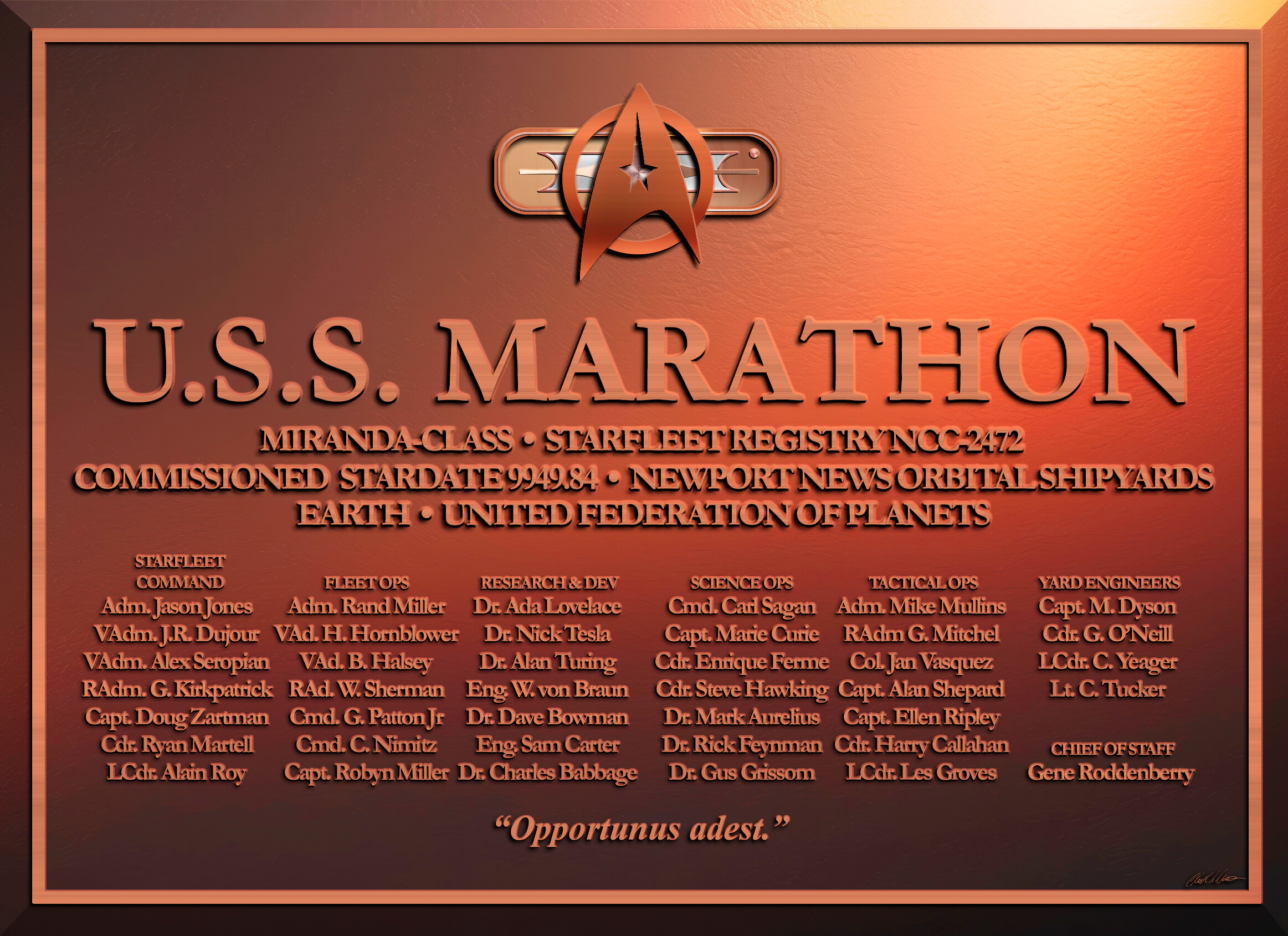
USS Marathon
Miranda-Class
NCC-2472
The USS Marathon was originally constructed as a Class XI, Flight-III Miranda-class cruiser between 2291 and 2294. Having been upgraded over the next 18 years thru Flight IV and Flight V standards, she’d go on to be a prototypical technology demonstrator, and progenitor ship once she had emerged from a temporal even in which she’d acquire new technologies not seen in the Federation. The USS Marathon traces it’s name to the Marathon Plains, in Greece, Earth, where a battle between 10,000 Athenian foot soldiers, under General Miltiades, defended against 20,000 strong force of mixed Persian forces… which the Athenians won with better skill, intelligence, gear, use of terrain, tactics and strategy.
History
Miranda-class — Design and Service Notes
The Miranda-class originated as a synthesis of multiple late 23rd century design studies. Early conceptual work drew heavily from the Avenger-type heavy frigate program, alongside elements from the Surya and Knox-class frigates, both of which emphasized tactical resilience and defensive strength. In parallel, Starfleet revisited the briefly paused Cyane-class cruiser program, which prioritized a broader multi-mission profile.
The convergence of these influences initially created ambiguity in classification. While the Avenger, Surya, and Knox designs aligned with heavy frigate doctrines, the Cyane framework introduced cruiser-level versatility. Ultimately, Starfleet assigned the Miranda-class a cruiser rate, reflecting its ability to operate independently across a wide range of mission profiles. In service, the class would validate this designation through consistent, adaptable performance.
Production and Flight Evolution:
The Miranda-class entered production in 2264. Early hulls (Flight I, 2264–2274) emphasized modularity and fleet support, with Flight I consisting of 189 ships. Flight II and III variants, with 122 ships and 143 ships respectively built from 2274 to 2297, introduced incremental improvements in systems integration and mission flexibility. Originally designed to counter innovations and advancements from the Klingon Defense Force, such as the D7 Battlecruiser, the Treaty of Organia saw a shift from combat oriented ship to a more multi-mission, survey oriented flexibility. The well recognized roll bar module from the 2274 Flight II overhaul, inline with the Tech Modification Program, would reintroduce a reasonable rearmament, after being “declawed” post treaty, therefore rounding out the design and truly giving the ship a flexible mission profile that would, as time would thoroughly point out, live up to the age old saying that “a jack of all trades is a master of none, but often times better than a master of one.” Shifts in interstellar geopolitics during the 2280s and 2290’s led Starfleet to emphasize a more tactically responsive—yet still versatile—mission profile for portions of the class.
The USS Marathon was one of 45 ships built as a transitional IIIA ship, still retaining much of the load out in common with the standard Flight III, but with upgrades that would inform the Flight IV ships introduced in 2297, and Flight V versions introduced in 2306. Documentation would still, generally, list them as Flight III ships.
Between 2297 and 2306, a major modernization program reshaped the class:
-Flight IV (2297-2306):
–Applied to:
—127 new Flight IV ships
—189 Flight I hulls (2264–2274)
—98 Flight III hulls (2284–2297)
Focused on structural reinforcement, improved systems commonality, and expanded mission capacity, and a total of 414 ships flying this standard until 2310. Upgrades to Flight V would take 5 years, ending in 2315.
-Flight V (2306-2336):
–Applied to:
—145 new Flight V ships
—122 Flight II hulls
—45 Flight III-derived hulls (including USS Marathon)
—-Upgrades would officially be considered Flight IV from 2297-2300, finalized as Flight V in 2306.
Expanded to a total of 312 ships (145 designated, 167 upgraded) between 2306 and 2336, with the
upgrades completed in 2310.
Flight IV and V ships represented the class at its operational peak. Changes included:
-Expanded cargo and logistics capacity.
-Increased transporter throughput.
-Larger crew complements, with emphasis on ship operations and flight crews.
-Reduced passenger accommodations in favor of operational capability.
-Improved weapons systems with better overall performance efficiency and coverage.
Flight V ships further incorporated:
-More powerful impulse propulsion.
-Integrated duotronic/multitronic computer systems.
-Prototype Isolinear systems for integrating cloaking systems.
-Longer ranged weapons systems.
-Overall more efficient performance.
-More mission flexibility, adaptability and modularity. Revised deck plan to this end.
Despite these upgrades, the class retained its defining characteristic: true multi-mission versatility. Miranda-class ships routinely supported fleet operations while remaining capable of extended independent deployment. Flight IV ships were a bit more science and survey heavy, where Flight V was more flexible and adaptable in their abilities to change mission and operational stance, while still retaining respectable science capabilities in it’s own right.
Operational Service:
Across the late 23rd and early 24th centuries, the Miranda-class served in an exceptionally broad range
of roles:
-Survey and scientific operations
-Logistics, transport, and communications support
-Border patrol and system defense
-Limited and sustained tactical engagements
They saw action or presence in multiple regional conflicts and tensions, including operations involving
the Tzenkethi, Cardassian Union, and Kzinti forces, later punctuated by sustained operations against
the Borg and Dominion.
Late-Service Flights and Doctrinal Shift:
Later production and refit programs reflected Starfleet’s gradual shift away from heavily combat-
oriented fleet structures:
-Flight VI (2336).
-Flight VII (2350).
-Flight VIII (2363): Refit standard applied to surviving hulls, featuring upgraded power generation but
comparatively modest weapons relative to contemporary designs. Flight VI and VII, had at least 194
ships built between them, with the Flight VIII, as mentioned, being entirely a refit deal.
By this stage, the Miranda-class had effectively transitioned from modular heavy cruiser of a highly versatile nature, thoroughly in their element on the frontlines and frontiers, to a versatile utility platform supporting fleets while still retaining modularity and multi-mission capabilities maintaining logistical, exploratory, scientific, and diplomatic functions increasingly favored by the Federation at that point. This shift away from combat abilities in favor of retaining the class’s still venerable strengths in other abilities left the remaining flights of Miranda-class ships rather underprepared for conflicts that would occur once the last of the ships were refit to Flight VIII standards in 2366, though still valuable and rugged ships in their twilight years. Despite Starfleet’s hurried efforts in the 2370’s to strengthen the class for operations in the Dominion War, ships of the last three flights, made or refit, had suffered quite a few losses, though it should be noted that the attrition rate was not all that much better for other ship classes, and conversely, several ships of the class had taken extensive damage and still managed to be easily and cost-effectively recoverable, repaired and brought back to service until the class was ultimately retired in the late 2380s. Overall, the attrition rate of the Miranda-class in it’s considerable lifespan, 126 years by retirement, was about one of every three made.
Legacy:
The full production run of the Miranda-class, 920 confirmed ships in total outside of offshoots and derivatives, represents more than a chapter in Starfleet history—it is a sustained demonstration of a design philosophy centered on modularity, versatility, and endurance. On that matter, there have been several variants built upon the main hull structure of the Miranda class including the Soyuz, Kresta, Avenger, Cyane, Hippocrates, and Endurance class frigates, the Daring-class Destroyer. Further variants of these, in the form of mission pod modules, include the Saratoga II long-ranged observation variant (Such as the ill-fated USS Saratoga, NCC-31911), the Antares AWACS/ISR variant, Soyuz C4ISR/Assault-ship variant, and Tempest torpedo/arsenal variant. In all, well over 800 other ships centered around the form factor of the Miranda were produced (e.g. Endurance, Hippocrates, Daring, and Kresta-classes), and a few more that had it’s main hull configuration incorporated into it (e.g. Hatfield, Illustrious, Impervious, Andernach-classes) Often overshadowed by more prominent contemporaries such as the Constitution, Excelsior, Ambassador, Galaxy, and Nebula-class ships, the Miranda-class nevertheless formed a critical and enduring component of the fleet’s backbone.
From scientific survey and exploration to logistics, communications, patrol, and defense, the class proved consistently capable across mission types. If a task needed doing—regardless of scale or prestige—there was a strong likelihood that a Miranda-class vessel was present. In this capacity, the class earned its reputation not through singular distinction, but through reliability, adaptability, and persistent service over more than a century of operation.
Starfleet had chosen to retire the Miranda-class and her offshoots by 2390, and honor the legacy by conceiving of, and constructing, the Reliant-class frigate. The Reliant-class retains much of the form factor, silhouette, and mission profile of the Miranda-class, as well as taking for it’s class name that of the USS Reliant NCC-1864, though not without some controversy. Some had deemed the Reliant a name steeped in tragedy concerning Khan Noonien Singh’s hijacking of the USS Reliant in 2285, marooning of her crew, and came too close to destroying the USS Enterprise under Admiral Kirk’s command for comfort. Those who had decided on the name had said it was to honor the crew for their valiant effort to resist Khan. The Reliant-class had started to phase-in where the Miranda-class ships were being pulled out, with the latter being transformed into training ships, frontier colony ships, and mostly transferred to boneyards and other facilities.
Technical Data
Full Technical Details
| Extended Specifications |
|---|
| General Information |
|---|
| Class | Miranda-class |
| Designation | Class XI Cruiser, Heavy Cruiser Configuration |
| Hull Duration | 250 Years |
| Time Between Refits |
SRA: 1 year EDSRA: 2 years RO: 4 years MO: 6-12 years
|
| Time Between Resupply | 4 years |
| Dimensions |
|---|
| Length | 243 meters |
| Beam | 150 meters |
| Draft | 64.25 Meters |
| Mass |
127,121 metric tons dry
139,466 metric tons fully loaded. |
| Personnel |
|---|
| Habitable Decks | 10 |
| Senior Officers | 15 |
| Other Officers and Enlisted Crew |
- Assigned Personnel;
- 30 commissioned officers
- 18 warrant officers
- 261 enlisted
- Embarked Personnel;
- 64 Operators or Marines
- 72 Flight Crew and Maintainers
|
| Civilians | None |
| Marines/MACO | 64 Naval Warfare Specialists |
| Evacuation Limit | 2,800 “comfortably,” 5,000 in dire situations |
| Propulsion Systems |
|---|
| Warp Drive Configuration | Standard |
| Warp Drive Units | 2x underslung Cochrane Warp Dynamics LN-64J Mod 12 FNWD-5A nacelles |
| Primary Impulse System | 1x Kloratis Drives FIJ-4 Subatomic Unified Energy Impulse Unit. |
| Slipstream Drive | Equipped |
| Transwarp System | Equipped |
| Speed |
|---|
| Avg. Cruising Speed | 8 |
| Max. Cruising Speed | 9.5 |
| Emergency Speed | 9.995 for 12 hours |
| Defensive Systems |
|---|
| Primary Shielding System | Sylvanesti Shields FNSU class 12 |
| Backup Shielding System | Prentice-Shaffer “CIDSS” Deflector Supplement |
| Additional Defenses | OSS Manufactured “MARBLE” Composite Armor with metallofullerene and nonlinear metamaterial coating. 127 to 330.2mm thick depending on location. |
| Offensive Systems |
|---|
| Phaser Systems |
- 6x Augusta Ansadado RIM-15A Twin Mount FNHX-34 Type XII-7 Phaser Banks
- 8x Augusta Ansadado RSM-15B Single Mount FNHX-34 Type XII-8 Single Phaser Emitters
- 2x Asakaze Ordnance Systems “Talon” Multi-direction Heavy Phaser Cannon FNHX-37-SFOESS Type XIV-12
- 20x OSS Munitions Systems Phalanx Concealable CIWS phaser mounts
|
| Torpedo Systems | 4x Skat-Rar Mk 95 FP-30-DS/BF Direct-Fire Photon/Quantum Torpedo Tubes |
| Torpedo Armament | 360 Photon and Quantum Torpedoes standard load;
- 72 Quantum Torpedoes, Class 3 (100 isotons, 348.8 mtons equivalent)
- 288 Photon Torpedoes, Class 6 (25 isotons, 87.2 mtons equivalent) |
| Scientific Systems |
|---|
| Sensor Systems |
- Teledyne DZX-76 Multi-band Linear Sensor Suite.
- Teledyne Omniwave Passive Sensor Suite.
- Rockwell JDOME Omnidirectional Sensor Array.
- Texas Instruments EM/Tachyonic Warfare Sensor Suite
- Raytheon Scope-VI Tactical Sensor Suite.
- Rockwell SDI-V Lateral Sensor Array, 144 pallets for sensor packages.
- Honeywell Echo-v5 Navigation Sensor Array. (local area navigation and hazard avoidance)
|
| Probe Systems | Equipped as needed |
| Deflector System | Vernier SB40 Integrated Navigational Deflector/Sensor System |
| Scientific Laboratories |
10 Science Laboratories;
- Tech 1) Encryption/decryption, networking and communications
- Tech 2) component design and fabrication
- Tech 3) Coding and security
- Astro 1) Planetology, meteorology, geography, oceanography
- Astro 2) Astronomy, astrophysics, stellar physics
- Astro 3) Stellar cartography, and celestial body mapping
- Astro 4) Electromagnetic study, spectroscopy
- Physics 1) Physics
- Physics 2) High energy and chaos physics
- Physics 3) Quantum physics
- Social sciences attached to comms and diplomats
- Life sciences attached to medical wing
- Metallurgy and material sciences attached to engineering
|
| Crew Support Systems |
|---|
| Medical Support Systems | Full suite medical center, deck seven |
| Recreational Systems |
- Gymnasium decks 4 and 5 port
- Rec Room decks 4 and 5 starboard
- 3x holosuites, deck 6 port bow
- Pub deck 6 bow
- Game room deck 7 bow
- Botany section, deck 6 port
|
| Auxiliary Information |
|---|
| Auxiliary Craft |
8x Valkyrie, Kodai or Alliance Valor Fighters, or 4x Gryphon fighters if needed.
2x Type-4 Shuttles with AWACS sensors fit;
2472/1 Huginn.
2472/2 Muninn.
2x Yellowstone Runabouts;
NCC-99556 USS Suikawari.
NCC-99762 USS Patomac.
—-Standard capacity: 18 people.
—-Emergency capacity: 45 people.
6x Type-14 Shuttles;
2472/3 Tyrell.
2472/4 Heinlein.
2472/5 Herbert.
2472/6 Seropian.
2472/7 Franklin.
2472/8 Aurelius.
—-Standard capacity: 12 people.
—-Emergency capacity: 30 people.
12x Workerbee utility craft.
|
| Specifications |
|---|
Length
Beam
Draft
Mass
|
243 meters
150 meters
64.2 meters
127,121 mt dry, 139,466 mt loaded
|
| Decks | 11, 10 habitable |
| Standard Crew | 460 total. 324 assigned, 136 embarked |
| Emergency Capacity | Up to 5,000 max. |
|
Armaments
|
- 20 Phaser Emitters (12 paired in twin mounts)
- 20 PDS Phasers
- 4 Phaser Cannons
- 4 Torpedo systems
|
|
Defenses
|
- Sylvanesti Shields FNSU class 12 conformal shield system
- Prentice-Shaffer “CIDSS” Deflector Supplement
- “MARBLE” Composite Armor. 127-330mm depending on location
- Double hull with interstitial layer
|
|
Auxiliary Craft
|
8x Valkyrie, Kodai or Alliance Valor Fighters, or 4x Gryphon fighters if needed
2x Type-4 Shuttles with AWACS sensors fit;
2472/1 Huginn.
2472/2 Muninn.
2x Yellowstone Runabouts;
NCC-99556 USS Suikawari.
NCC-99762 USS Patomac.
—-Standard capacity: 18 people.
—-Emergency capacity: 45 people.
6x Type-14 Shuttles;
2472/3 Tyrell.
2472/4 Heinlein.
2472/5 Herbert.
2472/6 Seropian.
2472/7 Franklin.
2472/8 Aurelius.
—-Standard capacity: 12 people.
—-Emergency capacity: 30 people.
12x Workerbee utility craft.
|
Power Generation
Primary Power Systems:
–General Electric GE-129 Series Type-14 Dual Crystal Intermix M/AMRA rated at 1800+ Cochranes
and 270 EW peak energy generation, modified by OSS Engineers.
–Normal operations capped at 27 EW, 81 EW in combat. Full power use possible, but never practically
needed.
Secondary Power Systems:
–10x FC180 Plasma-Induced Dual-Chamber D/T Fusion Reactor Units.
–2x AF5-80 Cold-Start Deuterium/Tritium Fusion Reactors.
Energy Conversion Systems:
–2x PEC2300-3-45-FE Dual-Phase Plasma Power Converters.
Tertiary and Emergency Power Systems:
–1 PJ Western Electric capacitor bank. (800 m3 space total)
–483 Daystrom Institute Cold Fusion micro-reactors, 97 PJ combined output. (Called “batteries” by the
marketers)
–General Atomics Muon-catalyzed fusion reactor for backup power and propulsion, in event of warp
core ejection.
–7x Americium-242m nuclear isomer batteries (141 year t½) for life support and emergencies.
—216 m3 a piece (1 TJ/kg) 1 PJ total.
—-222 years at 1 MW usage.
—-111 years at 2 MW usage.
—-44 years at 5 MW usage.
—-22 years at 10 MW usage.
Notes:
As with most, if not all, of the Marathon’s other systems, power generation tends to be a mix of what they jumped forward with, what they found on the way, and blending it into what is current by 25th century standards. Among the things brought back with them for use and integration is a more refined muon-catalyzation, nuclear isomer power cells, and a more efficient means of distributing power to where it needs to go. The ship had its entire main reactor system replaced with a modified GE-129 Type-14 dual crystal intermix reactor, and an intermix ratio capped at 10:1 matter-antimatter mix for normal operations, and 6.66:1 ratio burst for heavy fire combat operations before returning to a 10:1. This is to ensure that, while the reactor is capable of producing an incredible amount of energy, the reactor produces an energy load that won’t surge and irrevocably destroy systems, or the ship itself, from a fatal overload. The dual crystal setup in the intermix chamber also smooths out power production, reducing the chances of “dirty power,” subject to fluctuations that could adversely affect performance over time. Cold fusion reactors and nuclear isomer batteries ensure a reasonable power supply to remain partially mission capable, if the main reactor were to go inoperable, and even supplement main power for relatively minor boosts, should they be needed without tapping the imposed tamp on the reactor. Muon-catalyzed fusion reactors for impulse thrust and secondary power generation allow for a quicker startup of those systems, due to the requisite temperatures needed to start reactions being significantly reduced. While the typical life span of a muon particle is still 2.2 μs in their resting state, they are not so much stored as generated by equipment within the greater fusion reactor assembly, and then injected into the supply of fusionable material, dropping the temperature needed to start to process. This allows the ship to get underway with a reasonably reduced warm-up period compared to other ships.
Propulsion
- 1x Kloratis Drives FIJ-4 Subatomic Unified Energy Impulse Unit.
- 6x Orage Ijek Trentis I Reaction Control System.
- 8x Scarbak Propulsion Systems QASR Maneuvering Thrusters.
- 2x Kloratis Drives Reverse Thrust Manifolds.
- 2x Cochrane Warp Dynamics LN-64 Mod 3 FWG-1 Warp Drives. Updated by OSS to LN-64J Mod 12 FNWD-5A drives.
- –All other systems modified and refined by OSS propulsion shop specialists and engineers.
Impulse Speeds
- Full Impulse: 0.25c (unrestricted, pre and post jump)
- Quarter Impulse:
—18,737.03 km/s standard (equiv. USS Voyager)
—24,364 km/s max possible (burst)
- ⅛ Impulse:
—9,368.514 km/s standard
—12,182 km/s max possible (burst)
- “Ahead Slow”: 1,873.7 to 3,747.41 km/s
- “Slow Astern”: 1,873.7 km/s Max
- “Full astern”: 3,747.41 km/s
- “Standard Orbit” (assuming Earth or analogue):
—Geostationary: 3.138 km/s
—Low orbit (242 altitude): 7.6 km/s
- “Dead slow” Thrusters or very low thruster settings, as needed.
- “Make fast” and “Secure”: Maneuvering thrusters for attitude adjustment and fine tuned maneuversin conjunction with docking or coming aside.
- Speeds listed are straight line speeds, and reduced in a turn.
Warp Speeds
- Cruise:
—8 (1,024c, 1 ly in 8.56 hours)
—-7 years, 9 months, 2 weeks, 6 days, 4 hours to clear the Federation’s widest distance.
- Max Cruise:
—9.5 (1895c, 1 ly in 4 hours, 37 minutes, 48 seconds)
—-4 years, 2 months, 2 weeks, 3 days, 22 hours to clear the Federation’s widest distance.
- Emergency Microjump:
—9.993568 (10,000c, 1 ly in 52 minutes, 35 seconds)
—-Used within a star system (14 hours if needed, though it typically isn’t)
—–60 AU (diameter of Neptune’s orbit) in 3 seconds.
—–100 AU (diameter of Kuiper Belt’s outer edge, Sol) 5 seconds.
—–4,050 AU (farthest point in 2014-FE72’s orbit, Sol) 3 minutes, 22 seconds
- Emergency:
—9.973 for 24 hours (4,959.49c, 1 ly in 1 hour, 46 minutes, 12 seconds)
—-1 year, 7 months, 1 week, 2 days to clear the Federation’s widest distance.
—9.995 for 12 hours (11,516c, 1 ly in 45 minutes, 40 seconds)
—-8 months, 1 week, 6 days, 18 hours to clear the Federation’s widest distance.
- Advanced FTL Drives:
–QSD for 12 hours: 9.999945 (86,000c, 1 ly in 6 minutes) TNG/DS9/VOY/Pic era only
—-1 month, 3 days, 8 hours to clear the Federation’s widest distance.
–Transwarp for 2–3 hours: 9.99999747 (875,600c, 1 ly in 36 seconds) TNG/DS9/VOY/Pic era only
—-3 days, 8 hours to clear the Federation’s widest distance.
–Bulk-Space Drive, (Bulk-drive or BSD): Type II drive, 28,800 lightyear range, up to 6 hour recharge.
—-9,500,000c, 1 ly in 3.3 seconds
—-7 hours, 20 minutes to clear the Federation’s widest distance.
Notes:
The Marathon was around when the “great warp scale reset” happened in 2312, so the measurements are given in the current standards. Also, her mid-jump reconstruction has been with lighter materials with tensile strength matching or beating Starfleet metallurgy, at least of the time she was made, allowing for faster sub-light speed, faster time-to-speed, and more agility. Among the other improvements gained was an FTL drive that works on an entirely different, but not completely unknown paradigm, of travel. Of the more traditional FTL systems, the LN-64 warp nacelles were entirely overhauled to take advantage of the increase in power, durability and reliability, to achieve the higher speeds now considered normal within Starfleet’s inventory. That said, for as fast as she is now, she isn’t the fastest out there, with other ships in service attaining a 0.1 or 0.2 higher warp factor for maximum cruising speed. Higher speeds than 9.5 will tend to have a time limit, due to power and other concerns, it is still plenty fast enough for the crew and ship to get most places within a reasonable area quickly enough to be of service. QSD and transwarp drives will extend that range considerably, and the Marathon’s Bulk-Space Drive allow for greater range and response times once again, though the BSD is reserved for movements that require covering vast distances where more traditional means would take too long, or need to many recharge cycles to really be that much more effective.
Tactical and Defensive Systems
Fire Control Computers
- OSS Q-Com HYDRA Mk 2 Mod 4 Weapons and Fire Control System Package.
-RCA AEGIS Mk 12 Mod 4 Fleet Fire Control Add-On.
Electronic Warfare, Countermeasures, and Decoy Systems
- CGCP/SCDS Cloaking Generation, Penetration, and Stasis Countermeasure System. ;
-Upgraded and modified by OSS technicians with added SF/SSQ-86v2 MUTE System.
- Raytheon SF/SLQ-64CV2 “Flash Bang” System.
- 2x Mk12 Prairiewind Decoy Launcher Systems.
- 2x Mk10 Daystom Systems HP Holoprojector Systems.
- 2x IDS404 Naval Decoy Systems.
- ALQ-220H “Prowler” ECM/ECCM Suite.
Weapons
6x Augusta Ansadado RIM-15A Twin Mount FNHX-34-SFOESS Type XII phaser banks.
-current strength per emitter:
–990 kt/s low end, 118.8 mt/s high end at idle thrust.
–1.188 mt/s low end, 142.56 mt/s high end at full thrust.
–570.24 mton overload blast maximum.
—497.0592 to 596.471 PJ (0.49706 to 0.59647 EW/s) max, 2.386 EJ overload.
8x Augusta Ansadado RSM-15B Single Mount FNHX-34-SFOESS Type XII emitters.
-current strength per emitter:
–990 kt/s low end, 118.8 mt/s high end at idle thrust.
–1.188 mt/s low end, 142.56 mt/s high end at full thrust.
–570.24 mton overload blast maximum.
—497.0592 to 596.471 PJ (0.49706 to 0.59647 EW/s) max, 2.386 EJ overload.
2x Asakaze Ordnance Systems “Talon” Multi-direction Heavy Phaser Cannon FNHX-37-SFOESS Type XIV.
-current strength per barrel:
–1.288 mt/s low end, 160.83 mt/s high end at idle thrust.
–1.929 mt/s low end, 193 mt/s high end at full thrust.
–772 mton overload blast maximum.
–646.6790 to 776.0148 PJ. (0.64668 to 0.77602 EW/s), 3.23 EJ overload.
4x Skat-Rar Mk 95 FP-30-DS/BF Direct-Fire Photon/Quantum Torpedo Tubes
20x OSS Munitions Systems Phalanx Concealable CIWS phaser mounts.
-Anti-munition: 240 MJ/s per turret, 4.8 GJ/s for all 20 turrets.
-Anti-vehicle: 480 MJ/s per turret, 9.6 GJ/s for all 20 turrets.
Defenses:
- Sylvanesti Shields FNSU class 12 conformal shield system
- OSS Manufactured “MARBLE” Composite Armor
-Metallofullerene and non-linear metamaterial coating
-127 to 330.2 mm thick depending on location
Notes:
Offensive and Defenses were considerably changed from the Marathon’s original form. Due to the nature of their travels, it was necessary to accrue anything that would give them a still measurable chance of surviving an encounter, should one befall them. While the technology would go on to be integrated with Starfleet technology later on, upon their eventual return (as with most other things), this area was one of the few to which much was done. The ships weapons power was substantially boosted, shields were reinforced, and the ship was well and truly up-armored. The ship was, in it’s Flight IV and Flight V refits (2300-2312), equipped with a cloaking device that was advanced for its time, and integrated into the ship’s systems well enough for practical use as needed. It was disabled in 2312, pending removal later that year, due to the Tomed Incident and the subsequent Treaty of Algeron forbidding the Federation from developing cloak technology and many other stealth systems. The temporal event that took the Marathon forward, however, occurred before these systems could be physically removed, and these systems were developed further during the path forward to be a more nuanced setup, allowing for a stealth mode without cloaking that has so far performed admirably. Decoy, masking and spoofing systems were also bolstered respectably, adding to the defensive posture of the ship when needed. While the Marathon has been made significantly more survivable, post-jump, against larger ships like the Odyssey, Yorktown and Lexington class dreadnoughts or the Concorde, Sovereign, and Inquiry class “battlecruisers” of the Federation, and equivalent offerings among other factions… a one on one slugging match would be considered, quite obviously, not in any way ideal… as the Marathon is neither the most heavily shielded, heavily armored, or hardest hitting among all ships in the new era. Where the ship would, in fact, remain a viable field piece would be the mix of it’s offensive and defensive systems, propulsion, maneuverability, sensors, and other contributing factors to at least give it a true fighting chance, as well as the doctrine of not flying without at least one other “wing man.”
Command and Control Systems
Computer Systems
- OSS in-house manufactured Q-Com Crystalline Hypercore HAL “Antikythera” modular systems
- Every end-point system has their own SOC/SOM, to ensure ops if main computers or network is down
- Running TuringOS (POSIX based) version 7_2426.6. Code name: Big Bang.
Sensors, Navigaton, Comms
Sensors:
- Teledyne DZX-76 Multi-band Linear Sensor Suite.
- Teledyne Omniwave Passive Sensor Suite.
- Rockwell JDOME Omnidirectional Sensor Array.
- Texas Instruments EM/Tachyonic Warfare Sensor Suite
- Raytheon Scope-VI Tactical Sensor Suite.
- Rockwell SDI-V Lateral Sensor Array, 144 pallets for sensor packages.
- Honeywell Echo-v5 Navigation Sensor Array. (local area navigation and hazard avoidance)
Communications:
- Cisco Systems UV-5RM Communications Suite
Navigational Computer:
- OSS Q-Com Rubicon HyD-E Composite Navigational System Package
Notes:
The Marathon’s computer cores are really the major improvement, as well as the “in house” operating system developed to run on it. Sensors, communications and navigational computer are, relatively speaking, more an evolution by sophistication. The main computer cores are based on entirely different architecture than Starfleet standard computers, and the operating system software was initially cobbled together to take advantage of this, gaining in sophistication over time to become a mature and robust code base, based on the POSIX standards originating on Earth at least as far back as the 1990s. The main computer cores are also capable, and equipped, with five sophisticated meta-stable personality constructs that act as avatar and interface between ship and crew, beyond what the terminals, end-points, and other systems aboard already adequately provide. In the time since their being on-boarded, the crew has generally taken to them as though they were other members of the crew. Sensor systems aboard have also seen both a miniaturization compared to previous systems used, and sophistication, providing comparable range and granularity to newer ships that meets current standards, occasionally surpassing by a respectable, but not inordinate, amount.
Auxiliary Spacecraft
Standard compliment of small craft aboard typical includes eight Alliance Valor fighters, two Type-4 shuttles rigged with AWACS equipment, six Type-14 shuttles, two Runabouts, and twelve Worker Bee utility craft. This setup blends added defensive or offensive capability with assault capabilities, and the ability to conduct transporter inhibited away missions, evacuations, or whatever else is needed at the time. Other configurations include all shuttles or all fighters, and the cargo bay can be reconfigured to house more fighters and supporting equipment and munitions, if it’s deemed necessary for a particular mission, though a repurposed cargo bay for fighter storage precludes its use for housing evacuees.
Physical Arrangement & Crew Support
A narrative section, this can be as descriptive or not as you want!
Senior Officers
| Flag Officer | Commanding Officer | Executive Officer |
|---|
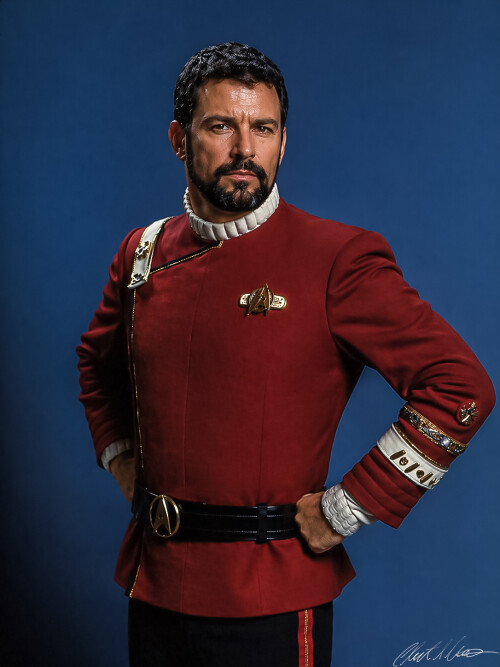
Adm McCullough (Human) |

Capt Lise Fuentes (Human) |

Cdr Benten Moshe (Bajoran) |
| Chief Science Officer | Chief Engineer | Chief Medical Officer | Chief of Security |
|---|

Cdr T’Shanik (Vulcan) |
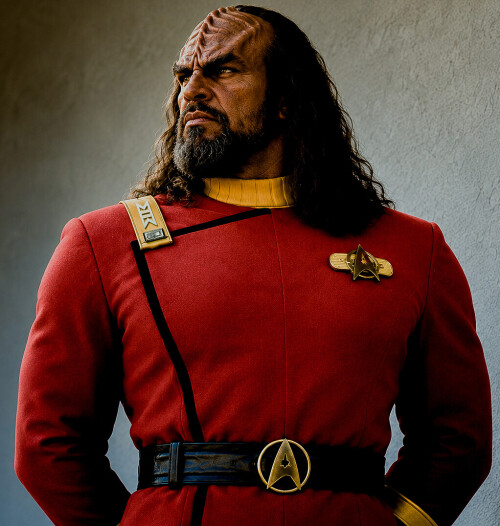
Cdr Kharak (Klingon) |
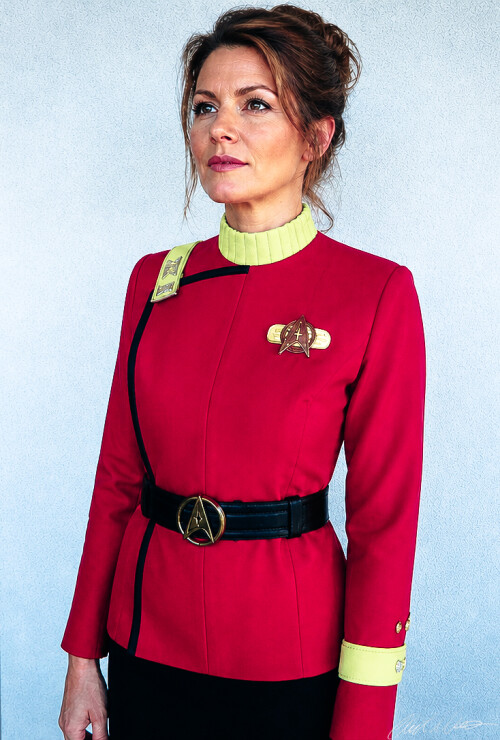
Cdr Elena Autry (Human) |

Cdr Lamal (Vulcan) |


